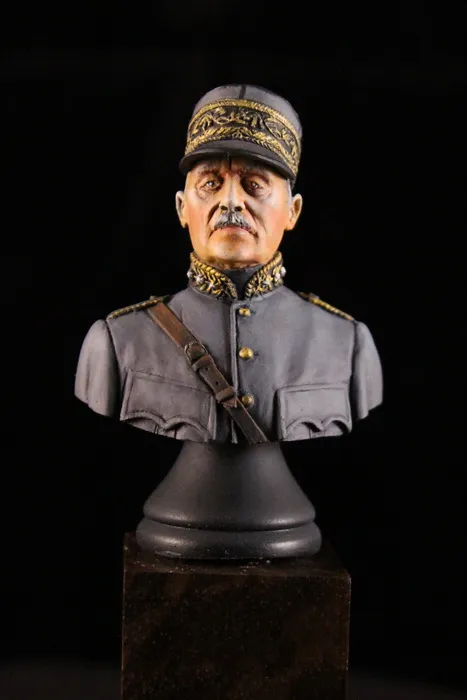
Historical · 1/15
Général Guisan
Henri Guisan, born on October 21, 1874, in Mézières, canton of Vaud, Switzerland, and died on April 7, 1960, in Pully, was the commanding general of the Swiss army during the Second World War.
His father, Charles-Ernest Guisan, was a doctor in Mézières. His mother Louise, née Bérengier, was originally from Vevey.
In 1893, Henri Guisan obtained his baccalaureate in literature after attending the cantonal classical college and the gymnasium in Lausanne. Henri Guisan first tried his hand at theology and law at the University of Lausanne before choosing agronomy, which he studied in Hohenheim, Germany, and in Lyon. In 1896, he bought the Bellevue estate in Chesalles-sur-Oron. He attended his artillery recruit school in Bière. Promoted to lieutenant in 1894, he successively rose through all military ranks to become a corps commander in 1932.
On August 30, 1939, the Federal Assembly appointed him General of the Swiss Army (a rank existing only in case of war risk), that is, Commander-in-Chief of the Swiss Army by 204 votes to 21falg 1, a responsibility he held throughout World War II (1939-1945). He was the author of the concept of the National Redoubt, aimed at withdrawing the army into the Swiss Alpine arc in case of invasion. A secret military agreement signed with France in 1939 fell into German hands in 1940. This was a serious danger for him and the Swiss Confederation.
On July 25, 1940, he gave an army report at Grütli that had a great impact both at home and abroad. Henri Guisan was also loved and respected in German-speaking Switzerland, where he spoke as much in Swiss German as in French.
On August 20, 1945, General Guisan asked the Federal Council to relieve him of his military responsibilities. Entering civilian life, he settled at the Verte-Rive estate in Pully, on the outskirts of Lausanne.
The day after his death, which occurred on April 7, 1960, several newspapers paid tribute to him. La Suisse wrote: "He embodied the Swiss citizen and, above all, the citizen soldier. He was the man and the leader of the situation during a troubled period in our history, when so many opposing forces were at work within the country. " In La Liberté, one can read: "that he left us without a shadow or a failure clouding the clarity. Henri Guisan was one of those men whom Providence places on the path of the peoples it wants to lead, and who so fully incorporate themselves into their mission that they seem to have always been made for her. " As for the socialist daily La Sentinelle, it notes: "what the workers and soldiers liked about the general was his simplicity and naturalness. His justice was the same for everyone. Because of his qualities as a man, General Guisan had managed to create a new spirit between the army and the people. »
His funeral was attended by more than 300,000 people and is in fact the most attended procession in Switzerland in this honor.
He was married to Mary Doelker (1875-1964), with whom he had two children, Henri, born February 13, 1899, and Myriam, born December 2, 1900.
Source: Wikipedia
This bust is currently exhibited at the Vaud Military Museum - Château de Morges and its museums.
- Type
- Figure
- Category
- Historical
- Genre
- Bust
- Scale
- 1/15
- Techniques
- Oil
- Status
- Collection
- Brand
- Historex